

The Secret City Beneath Kansas: Ellinwood’s Hidden Underground World
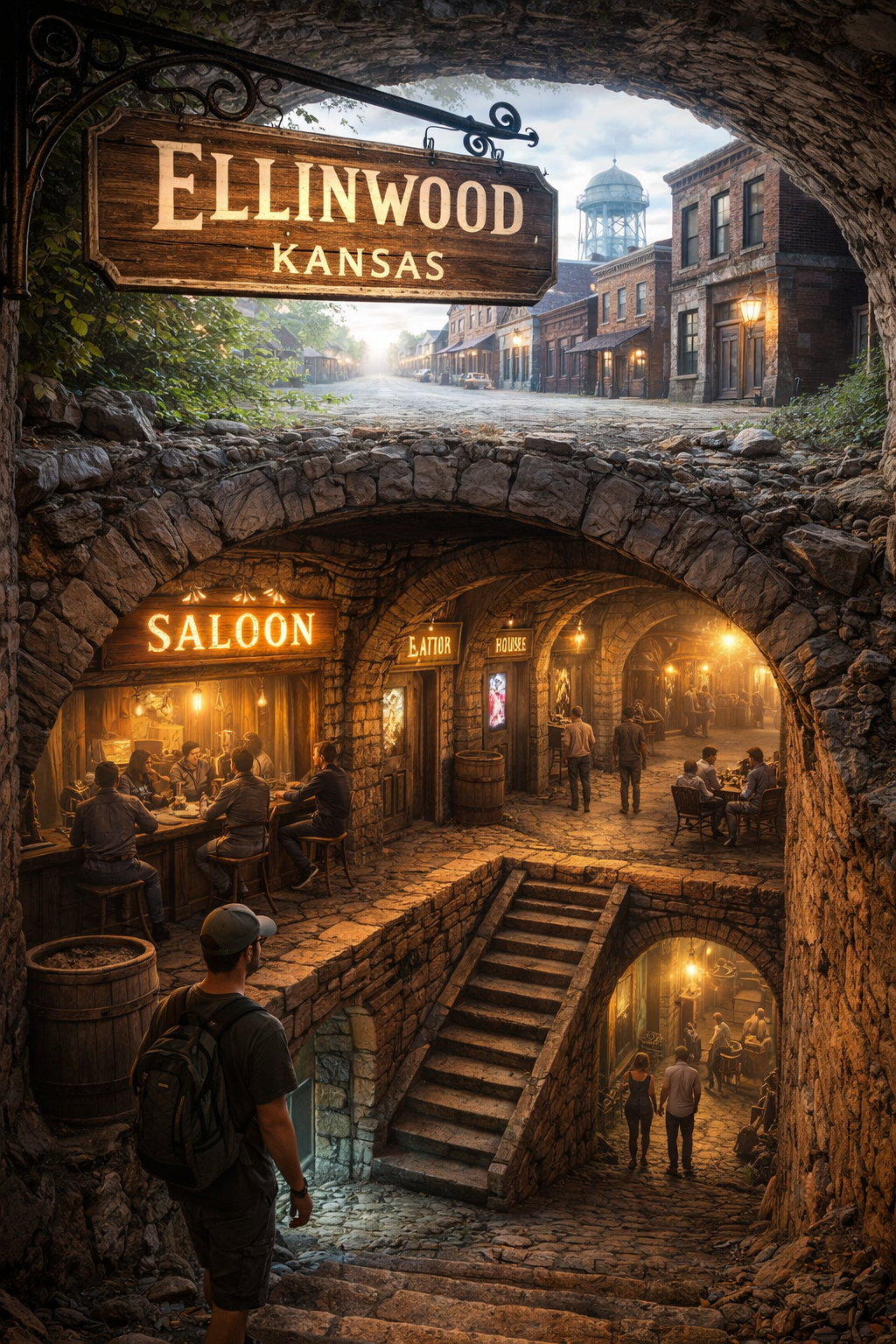
Is it as creepy as I think?
What Lies Beneath The Hidden Underground City of Kansas…
That’s right friends, when most people drive through Ellinwood, Kansas, they probably think they’re just looking at another quiet and small Kansas town on the prairie. Just a few brick buildings… A water tower… maybe even a pickup truck or two rolling down Main Street.
But what most people don’t realize is that an entire hidden world exists beneath their feet. AND YOU’D NEVER EVEN KNOW IT EXISTED!
And we’re not talking just a cellar or two.
We’re talking about an entire FREAKING underground town.
Back in the late 1800s, Ellinwood was a bustling stop along the Santa Fe Trail, one of the most important trade routes in the American West. Wagons, merchants, cowboys, and travelers passed through constantly. And where there are travelers… there’s always a demand for entertainment.
Now here’s where things get interesting.
Kansas, at that time, had strict temperance laws: there are rules designed to limit alcohol and other “unsavory” activities. On paper, it meant that Ellinwood was supposed to be a fairly proper town.
But anyone who knows frontier history knows one thing:
The Wild West rarely cared much about paperwork. It loved its booze, bulls, and bibles.
So local entrepreneurs came up with a brilliant solution.
If you can’t run a saloon above ground, you run it below ground.
And that’s exactly what they did. “Sneaky girl…”
The Underground City
Throughout the late 1800s, Ellinwood quietly built a network of underground tunnels and rooms beneath its downtown buildings.
These spaces weren’t just small basements. Many were full-fledged businesses connected by corridors beneath the streets.
Down there you could find:
• Saloons
• Gambling halls
• Bath houses
• Barber shops
• Hotels
• And yes… even brothels… DA DA DAAAAAA…
Basically, if a traveler in the 1880s wanted a drink, a card game, a shave, or a night’s entertainment… chances are good they found it beneath Ellinwood.
Meanwhile, above ground, the town maintained the appearance of being perfectly respectable. The ultimate yin to the yang dualistic society. Right beneath your very steps!
It was essentially the Victorian version of a secret nightlife district.
And the underground scene was booming.
Why Underground?
Running these businesses underground served a few purposes.
First, it helped avoid the attention of law enforcement and temperance advocates who were trying to regulate alcohol and vice across Kansas.
Second, and probably just as important for Kansans, it helped regulate temperature.
Kansas summers are hot. REALLY FREAKING HOT…
Kansas winters are cold. REALLY FREAKING COLD…
But underground?
The temperature stays cool in summer and warmer in winter, making it surprisingly comfortable year-round. And for businesses operating late into the night, that was a big advantage.
Finally, the underground offered something frontier towns always valued:
Privacy.
Travelers passing through town could enjoy a drink or a card game without drawing attention.
What happened underground… stayed underground. Who knew Vegas was modeled after a small town in Kansas.
A Town Beneath the Town
By the height of Ellinwood’s boom years, the underground district had grown into a full network of rooms and hallways beneath several buildings downtown.
Workers, gamblers, travelers, and businessmen all passed through these hidden spaces.
Imagine walking down a dusty Kansas street in 1885.
Above ground, you might see a quiet storefront or a hardware shop.
But below your boots?
There could be a crowded saloon, a poker game, and a barber trimming someone’s mustache by lantern light.
It’s the kind of thing that sounds like it came straight out of a Western movie.
Except in Ellinwood… it was real.
The Underground Sleeps
Eventually, times changed.
Railroads shifted, travel patterns evolved, and many of the underground businesses closed. Over time the tunnels were sealed, forgotten, or simply left alone.
For decades, many locals barely talked about them.
But the underground city never disappeared.
It was just… waiting… UNTIL IT COULD BE DENIED NO LONGER!
Rediscovering Ellinwood’s Hidden History
In recent years, historians and preservation groups began uncovering and restoring parts of Ellinwood’s underground district.
Today visitors can actually tour sections of these tunnels and rooms, stepping back into a world that existed more than a century ago.
Walking through the spaces feels almost surreal.
Old brick walls.
Low ceilings.
Hidden staircases.
Rooms that once echoed with laughter, music, and the shuffle of playing cards.
It’s a direct connection to a time when Kansas towns were rougher, wilder, and full of characters trying to carve out a life on the frontier.
And in Ellinwood’s case…
Sometimes they carved it underground.
Kansas History You Don’t Expect
Kansas is often associated with wide-open skies, wheat fields, and quiet small towns.
But stories like Ellinwood’s underground district remind us that the state’s past is far more colorful… and yes, far more interesting than people might expect.
Because beneath the peaceful streets of this small Kansas town lies a reminder of the ingenuity, rebellion, and creativity of the frontier era.
Because when the rules said you couldn’t run certain businesses above ground…
The people of Ellinwood simply built another town below it.
And more than a century later, that hidden world still tells one of the coolest and most unexpected stories in Kansas history.
KW-N8
HEY YOU… YES YOU!!!!
Do you like discovering Kansas’ hidden legends with us?
Here’s the thing… Nate and James burn a lot of fuel (and even more coffee) tracking down these stories across the state. If you’d like to support the journey, you can always buy us a cup of coffee for the road. It helps keep the adventures rolling.
Just click here and do what you can… or not… most importantly, keep reading!
